
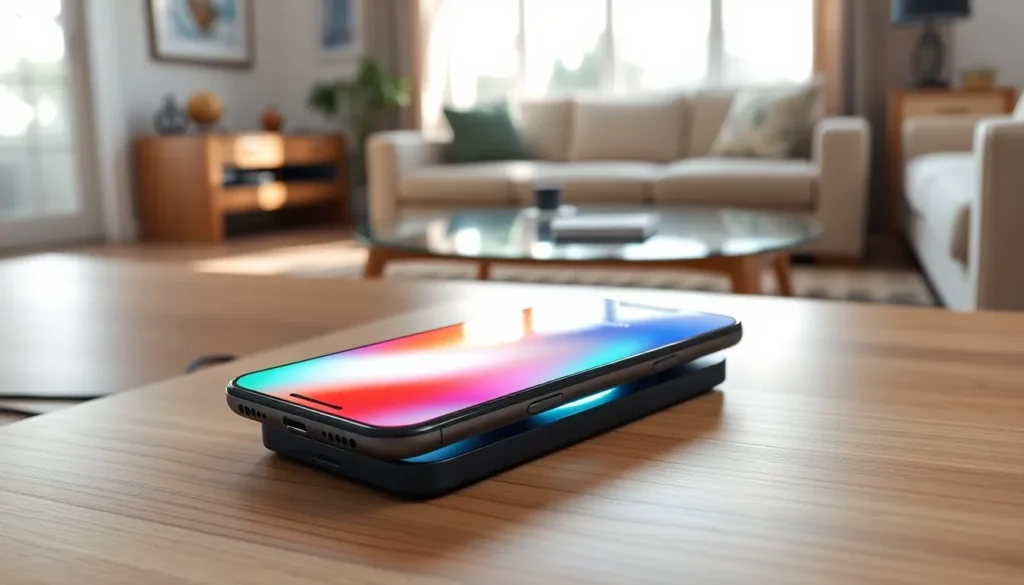
Picture this: you’re running late for work, and your phone’s battery is on life support. Panic sets in as you fumble for that tangled mess of charging cables. Enter wireless charging—a game changer in the world of tech that’ll make those frantic moments a thing of the past. No more wrestling with cords or praying for a power outlet; just place your device on a pad and let the magic happen.
Wireless charging isn’t just about convenience; it’s about embracing a future where technology works for you, not the other way around. With sleek designs and growing compatibility, it’s time to ditch the cords and join the wireless revolution. So, why not kick back, relax, and let your gadgets charge while you sip your coffee? It’s the modern way to power up, and trust us, your sanity will thank you.
Overview of Wireless Charging
Wireless charging relies on electromagnetic fields to transfer energy from a charger to a device. This method utilizes inductive coupling, where a charging pad creates an oscillating magnetic field. Devices equipped with compatible receivers convert this magnetic energy back into electrical energy, allowing for seamless charging.
Range varies between different wireless charging technologies. Qi, the most widespread standard, offers charging distances of up to 4 centimeters. Some newer technologies promise increased distances, but the efficiency typically diminishes with greater separation.
Efficiency rates also play a significant role in user experience. On average, wireless charging systems achieve about 70-80% efficiency, while wired chargers often surpass 90%. However, advancements in technology continue to improve wireless charging efficiency, making it a more viable option for everyday use.
Charging speeds can differ based on technology and device compatibility. Standard Qi chargers provide about 5 to 10 watts, while rapid chargers can deliver up to 15 watts or more. Devices supporting higher wattage can charge more quickly, reducing downtime significantly.
Users benefit from the convenience of wireless charging. There’s no need to fumble with cables or connectors. Simply placing a device on the charging pad initiates the charging process. Various manufacturers produce wireless charging accessories, offering a range of styles and functionalities tailored to different devices.
Safety features are integrated into most wireless charging systems. Overheating protection, foreign object detection, and automatic power adjustment help prevent damage to both the device and charger. As technology evolves, safety standards strengthen, ensuring a reliable user experience.
The growing adoption of wireless charging promotes a shift toward cable-free environments. Many smartphones, smartwatches, and earbuds now incorporate this technology, enhancing user convenience. Overall, wireless charging presents a forward-thinking solution in the technology landscape.
How Wireless Charging Works
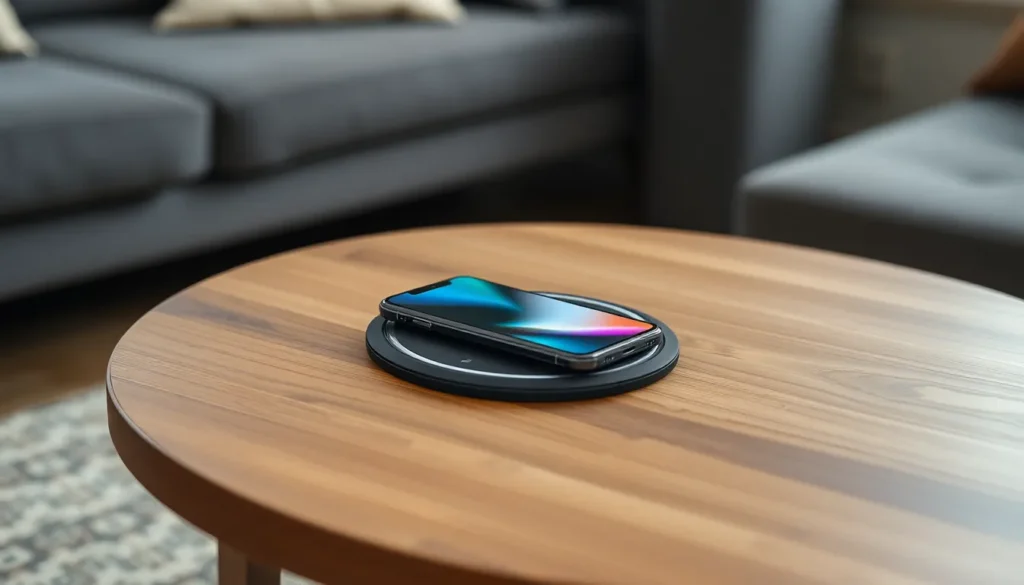
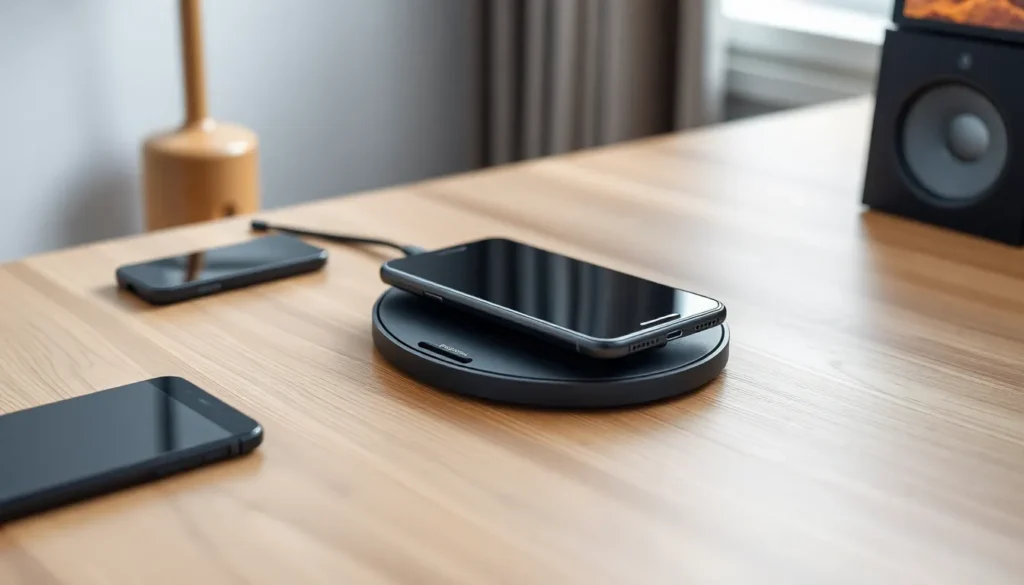
Wireless charging operates by utilizing electromagnetic fields to transfer energy between a charging pad and a compatible device. Two main technologies enable this process: inductive charging and resonant charging.
Inductive Charging
Inductive charging employs two coils: a transmitter coil in the charging pad and a receiver coil within the device. When the pad is powered, it generates an electromagnetic field. The device detects this field and converts it back into electrical energy via the receiver coil. Efficiency typically ranges from 70% to 80%. This form of charging works best at distances under 4 centimeters. As a result, users must align their devices centrally on the pad for optimal performance.
Resonant Charging
Resonant charging differs as it uses resonant inductive coupling, allowing for greater distances between the charging pad and the device. This method relies on two coils tuned to the same frequency. When they are in range, energy transfer becomes efficient even at distances beyond 4 centimeters. With advancements in this technology, resonant charging supports multiple devices simultaneously and maintains higher charging speeds. Furthermore, it addresses the need for flexible placement, enhancing user experience in cable-free environments.
Benefits of Wireless Charging
Wireless charging provides multiple advantages that significantly enhance the user experience. It combines convenience, efficiency, and modern technology into one streamlined solution.
Convenience and Ease of Use
Convenience plays a central role in wireless charging. Users can initiate charging by simply placing their devices on a pad, eliminating tangled cords and the constant search for power outlets. The absence of cables improves accessibility and usability across various situations, enhancing everyday interactions. Many devices like smartphones and smartwatches now incorporate this feature, making it easy for users to keep them powered with minimal effort. Charging multiple devices simultaneously becomes feasible with such technologies, promoting a truly cable-free environment.
Reduced Wear and Tear
Reduced wear and tear on devices represents another benefit of wireless charging. Traditional charging methods often cause physical stress on ports and connectors. In contrast, wireless charging eliminates the need for direct contact, preserving port integrity and lifespan. This aspect becomes crucial for long-term device usability. Moreover, the lack of plugging and unplugging decreases the likelihood of damage to connectors, ensuring devices remain in optimal condition. Enhanced durability results in lower maintenance costs and a better overall experience for users, ultimately supporting a more sustainable approach to technology.
Challenges of Wireless Charging
Wireless charging presents several challenges impacting its adoption and efficiency. Understanding these obstacles is essential for users seeking optimal charging solutions.
Efficiency Concerns
Efficiency remains a significant concern in wireless charging technology. On average, wireless systems achieve 70-80% efficiency, which contrasts with wired chargers often exceeding 90%. Energy loss occurs during the transfer process, leading to longer charging times. Newer technologies may enhance efficiency but have not yet become widely implemented in consumer products. As advancements continue, increased efficiency is anticipated, yet current limitations affect user experience.
Compatibility Issues
Compatibility poses another hurdle in the wireless charging landscape. While the Qi standard is widely adopted, diverse devices use different charging protocols. Many users encounter situations where their devices won’t charge on certain pads, creating frustration. Frustration stems from the lack of universal standards across brands, leading to confusion and inconvenience. Continued collaboration among manufacturers could improve compatibility and expand the technology’s use across various devices.
Future of Wireless Charging Technology
Emerging innovations promise to enhance the future of wireless charging technology significantly. Companies are exploring faster charging speeds, aiming for rates exceeding 15 watts. These advancements could reduce charging time, making wireless methods as efficient as traditional wired systems.
Research focuses on improving efficiency in energy transfer. Recent studies indicate that achieving over 90% efficiency is a primary goal in developing new technologies. Inductive and resonant charging systems are expected to evolve, addressing current limitations in distance and compatibility.
Integration into everyday environments is a key trend. Future charging stations may appear in public spaces, such as cafes, airports, and offices, enabling charging without the need for cords. This approach fosters greater convenience and encourages widespread adoption.
Increased device compatibility represents another priority. Standardized technologies among manufacturers could minimize user frustration caused by charging pad incompatibilities. Collaborations across brands can enhance the overall user experience and broaden the appeal of wireless charging.
Enhancements in safety features also play an essential role in future developments. Advanced systems will include better protection against overheating and potential hazards. Improved reliability builds trust among consumers, encouraging them to embrace wireless solutions.
Lastly, the potential for new applications lies ahead. Future advancement may extend to electric vehicles, smart home devices, and wearables, making wireless charging an integral part of daily life. As technology advances, it will continually reshape user interaction with devices, leading to more efficient and seamless experiences.