

Military drones might look like high-tech toys, but they’re more like stealthy hawks monitoring the skies. These unmanned aerial vehicles (UAVs) come in various sizes, from the small ones that could almost fit in a backpack to the behemoths known for their wingspans longer than a Boeing 737. But just how big are these machines, and what does size really mean in a military context? In this text, we’ll jump into the intriguing realm of military drones, their sizes, and what factors influence their design. You won’t just learn their dimensions: you’ll discover how these machines have transformed modern warfare. Buckle up.
Overview of Military Drones
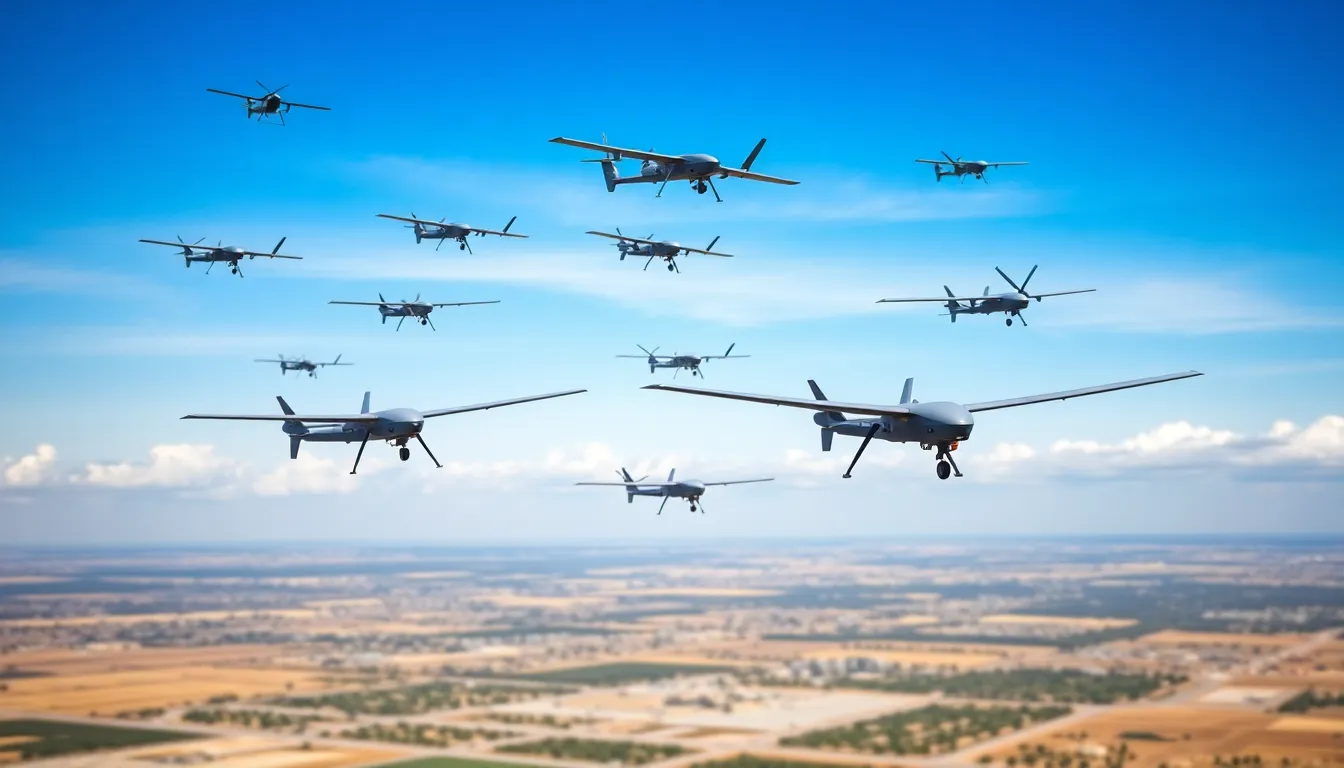
Military drones, also known as unmanned aerial vehicles (UAVs), have revolutionized aerial warfare and reconnaissance. Historically, drones started as rudimentary devices, often employed for target practice. Fast forward to today, and they play critical roles in intelligence gathering, surveillance, reconnaissance, and even combat operations. Their sizes vary significantly, reflecting specific mission requirements. From small tactical drones to large HALE (High Altitude Long Endurance) models, each design serves a unique purpose on the battlefield. The versatility of these machines allows militaries around the globe to adapt to changing combat scenarios efficiently.
Types of Military Drones and Their Sizes
When discussing military drones, it’s essential to categorize them based on their functionalities. The primary types include:
- Tactical Drones
These are smaller UAVs, often portable, and primarily used for battlefield reconnaissance and surveillance. An excellent example is the Raven, a tactical drone that measures about 5 feet in wingspan.
- Medium Altitude Long Endurance (MALE) Drones
MALE drones like the MQ-1 Predator are larger, with wingspans around 55 feet. Designed for extended missions, they can carry payloads that include cameras and missiles.
- High Altitude Long Endurance (HALE) Drones
Think of the Global Hawk, which boasts a wingspan of roughly 130 feet. These UAVs fly at high altitudes for long periods, gathering vast amounts of data.
- Combat Drones
Drones such as the MQ-9 Reaper can be quite sizable, with a wingspan exceeding 66 feet. These drones are equipped for direct combat, able to carry missiles and perform strikes.
Each type serves specific roles in warfare, emphasizing the varied sizes and capabilities that military drones employ.
Factors Influencing The Size of Military Drones
Several factors determine the size of military drones. Let’s explore some of the most influential elements:
- Mission Requirement: The purpose of the drone significantly dictates its size. For example, drones designed for surveillance need extensive sensor capabilities and, so, larger physical structures to accommodate them.
- Payload Capacity: The types of equipment and armaments a drone carries are crucial. A UAV intended for combat must be robust enough to carry missiles and additional fuel, affecting overall size.
- Flight Range: Drones designed for long-range missions often require larger wingspans to enhance aerodynamics and fuel efficiency. As a result, many HALE drones adopt significant sizes to cover extensive geographical areas.
- Stealth Technology: Military advancements in stealth technology necessitate designs that might not align with traditional sizes. Drones often get larger to incorporate features like radar-absorbent materials, which could further reshape their dimensions.
Comparison of Military Drones with Other Drone Categories
When comparing military drones with other drone categories, the differences in size become starkly apparent.
- Commercial Drones: Hobby drones, popular for personal use and photography, typically measure around 12 to 24 inches in width. While they are incredibly versatile for civilian applications, they lack the size and capabilities of military variants.
- Agricultural Drones: These drones are tailored for crop monitoring and can range from 3 to 10 feet in wingspan. Their design focuses on carrying sensors rather than heavy munitions, underscoring their entirely different operational purpose.
In essence, military drones are generally larger than commercial or agricultural models, reflecting their advanced functionalities and mission-critical roles.
Current Trends in Military Drone Development
The landscape of military drone development is rapidly evolving, influenced by technological advancements and changing combat roles.
- Increased Autonomy: The trend is shifting towards creating drones that can operate with minimal human intervention. Autonomous systems enhance efficiency but also necessitate larger formations to accommodate extensive technology.
- Integration with AI: Integrating artificial intelligence into drone systems has become commonplace. AI requires processing units and larger onboard systems, contributing to increases in size and complexity.
- Hybrid Models: Military forces are exploring hybrid drone models that combine features from both UAVs and conventional aircraft. As a result, these models can become substantially larger, aiming to leverage dual capabilities.
Future Prospects for Military Drone Sizes
As military technology continues to advance, the future of drone sizes becomes a fascinating topic. Potential trends include:
- Miniaturization: While larger drones serve various purposes, there’s a push towards miniaturizing technology to create highly advanced, compact drones. Such drones, often measuring a few feet across, could perform critical surveillance and reconnaissance missions discreetly.
- Mega Drones: On the opposite end, we may also see the development of larger, more sophisticated drones designed for multi-role operations. These could have substantial payload volumes and enhanced capabilities, standing as command centers in the sky.
- Collaboration: Future military tactics might involve swarms of smaller drones working together to perform extensive operations, combining their smaller sizes for flexibility while maintaining operational efficiency.